
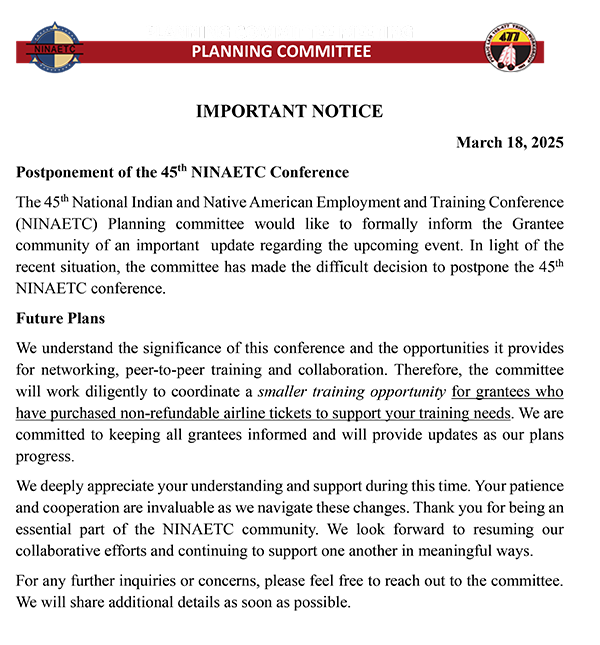
NATIONAL TRAININGPOSTPONED45th National Indian and Native American Employment and Training - WIOA Section 166 / Public Law 102-477 |
REGIONAL TRAINING
To be announced
40th National Indian and Native American Employment / Public Law 102-477 Training
39th National Indian and Native American Employment / Public Law 102-477 Training
37th National Indian and Native American Employment / Public Law 102-477 Training
Serious Concerns from the (2018) 39th NINAETC/477 Training Conference and the USDOL National Native American Employment and Training Advisory Council
Letter from Coyote Valley Band of Pomo Indians
Letter from Scotts Valley Band of Pomo Indians
Information on the Workforce Innovation and Opportunity Act
The National Indian and Native American Employment and Training Conference (NINAETC), established in 1979 is the largest and most representative national Indian and Native American employment and training association. NINAETC serves the needs of a broad membership of Indian and Native American tribal governments, consortia, and organizations. The NINAETC is organized as a representative voice of consensus on national employment and training issues. Our main purposes are to:
National Indian and Native American Employment and Training - WIOA 166 / Public Law 102-477 In 2015, the NINAETC joined forces with the Public Law 102-477 Tribal Work Group. PU 102-477 is the "Indian Employment, Training and Related Services Demonstration Act of 1992." This law authorizes the integration of employment, training, and related services provided by Indian tribal governments. The annual event now provides training for both grantees who are funded under Section 166 of the Workforce Innovation and Opportunity Act and the Public Law 102-477 Act. The NINAETC currently enjoys a valued partnership with the U.S. Department of Labor, Division of Indian and Native American Programs and the U.S. Department of the Interior, Division of Workforce Devlopment. Our partnership principles and activities are:
~~~~~ |
NINAETC Conference History